

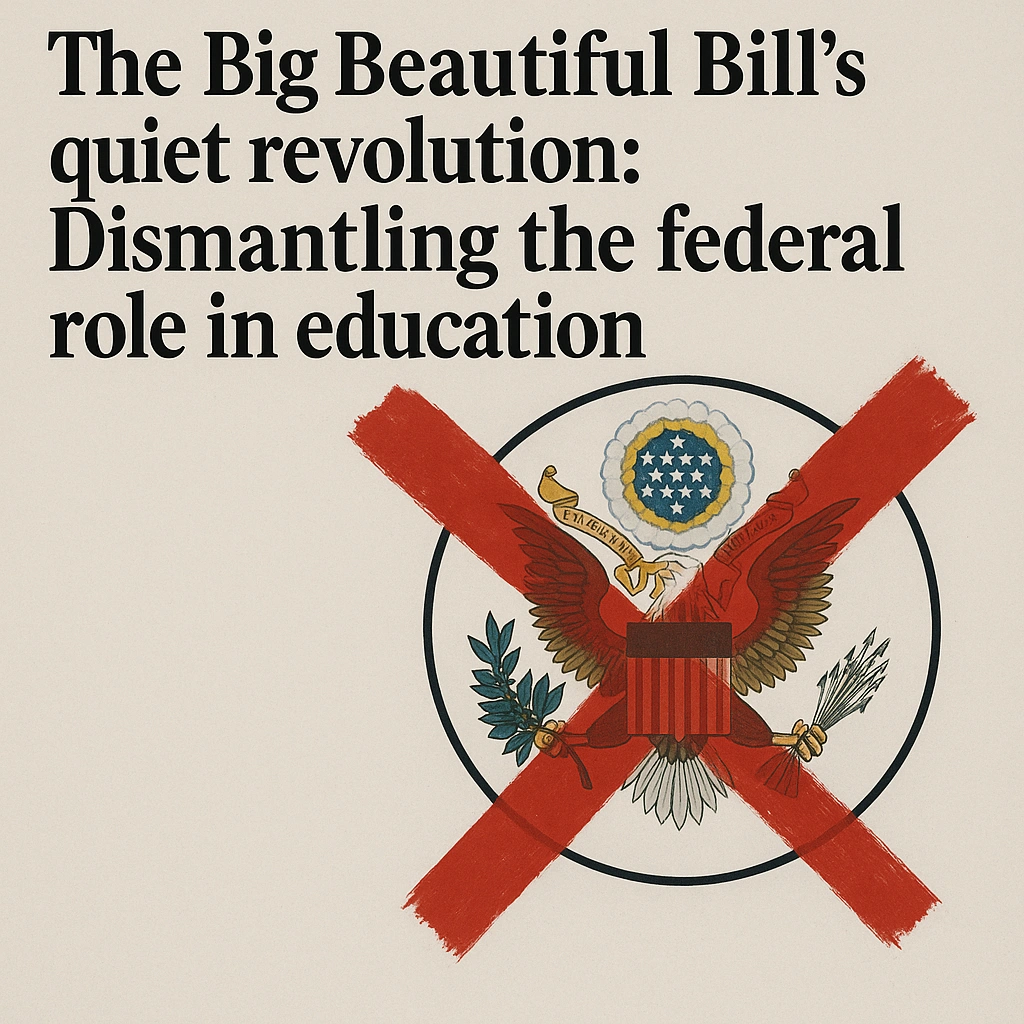
In the halls of Congress, away from the usual media spectacle, a legislative proposal has been quietly gaining traction. Nicknamed “The Big Beautiful Bill” by its fervent supporters and critics alike, this piece of legislation aims to dismantle the federal government’s role in public education, returning control to the states and local communities. While it hasn’t grabbed headlines like some hot-button culture war issues, its potential impact on the American education system is profound, permanent, and polarizing.
This 1500-word article explores the origins, goals, supporters, critics, and far-reaching implications of this bill that could fundamentally redefine who gets to decide how America’s children are educated.
What Is “The Big Beautiful Bill”?
At its core, The Big Beautiful Bill (formally titled the American Education Sovereignty Act) proposes a dramatic shift in the architecture of public education governance:
-
Abolishing the U.S. Department of Education (USDOE) within five years.
-
Reallocating education funding directly to states via block grants.
-
Allowing states to set their own curriculum, testing standards, and accreditation without federal oversight.
-
Ending federal enforcement of education-related civil rights legislation such as Title IX and IDEA (Individuals with Disabilities Education Act).
Introduced by Rep. Thomas Redman (R-TX) and Sen. Cynthia Hale (R-ID), the bill is framed as an effort to restore local control, reduce federal bureaucracy, and empower parents and teachers.
“Education belongs in the hands of families, not federal bureaucrats in Washington,” said Rep. Redman at a recent town hall.
The Ideological Roots: States’ Rights and School Autonomy
The bill is the culmination of decades of conservative advocacy against perceived federal overreach into education — an issue that has united libertarians, populists, and some moderate Democrats concerned about Washington’s growing footprint.
Critics of the current system argue that the USDOE has bloated into an expensive, inefficient body that enforces one-size-fits-all mandates ill-suited for local needs. They point to policies such as Common Core, No Child Left Behind, and Race to the Top as examples of federal interference that burden schools with testing, paperwork, and politicized curricula.
“For too long, federal standards have stifled creativity in the classroom,” said Jenny Barkley, a charter school administrator from Arizona. “The Big Beautiful Bill gives power back to educators.”
The Mechanism: What the Bill Would Actually Do
1. Phase-Out of the US Department of Education:
The bill sets a five-year timeline to dissolve the USDOE, laying off nearly 4,000 employees and transferring essential data and compliance operations to a smaller, non-regulatory body under the Department of Interior.
2. Block Grants to States:
Federal education funds would be distributed directly to states with no strings attached, giving them total control over how to spend the money — from teacher salaries to new infrastructure or even school choice vouchers.
3. Deregulation of Standards:
States could opt out of national standardized testing requirements, federal accreditation norms, and special education mandates. This effectively allows each state to build a unique education model.
4. Parent Oversight Boards:
The bill encourages (though does not require) the formation of Parent-Elected Oversight Boards at the district level to monitor school performance and spending.
Supporters Cheer “Local Liberation”
Supporters hail the bill as a long-overdue correction that empowers families, liberates teachers from bureaucratic red tape, and reintroduces educational diversity into a system that has grown too homogenized.
“I want my state, not some unelected official in Washington, deciding what my child learns in school,” said Erika Maddox, a mother of three from Georgia and vocal supporter of the bill.
Many Republican governors, including Greg Abbott (TX) and Ron DeSantis (FL), have thrown their support behind the bill, arguing that their states already have strong systems in place and would flourish without federal restrictions.
The Heritage Foundation, Cato Institute, and American Legislative Exchange Council (ALEC) have all issued glowing endorsements, calling the bill a “milestone in the fight for educational freedom.”
Critics Warn of Chaos, Inequality, and Civil Rights Violations
On the other side, the bill’s opponents — a wide coalition of educators, civil rights activists, disability advocates, and urban school districts — are sounding the alarm.
1. Fear of Educational Inequality
Without federal guidelines, critics warn, wealthy states and districts will soar while poor, rural, or minority-majority schools may flounder.
“This is a recipe for institutionalized inequality,” said Dr. Michelle Ruiz, an education policy expert at Stanford University. “The federal government plays a key role in leveling the playing field.”
2. Erosion of Special Education Rights
The proposed repeal of IDEA mandates has sparked fierce backlash from disability rights groups who fear that children with special needs will be abandoned if protections are left to state discretion.
3. Loss of Title IX Protections
Title IX, which protects students from gender-based discrimination, is also at risk. Activists argue that this could roll back decades of progress in gender equity, particularly in sports and higher education.
4. Curriculum Fragmentation
A total devolution of curricular control could lead to wide disparities in academic rigor, graduation standards, and college readiness.
“A child in Mississippi could graduate without knowing what a child in Massachusetts learns in 8th grade,” warned Randi Weingarten, President of the American Federation of Teachers.
The Legal Minefield: Is It Even Constitutional?
The bill would likely face several legal challenges. The 14th Amendment and several Supreme Court rulings affirm federal authority in ensuring equal access to education. Removing civil rights protections could trigger lawsuits from advocacy organizations and affected families.
Additionally, the dismantling of USDOE would require significant restructuring of over 100 federal statutes, including the Every Student Succeeds Act (ESSA), Pell Grant systems, and federal student loan infrastructure.
“The logistical and legal hurdles are immense,” said Harold Kim, a constitutional law professor at Yale. “But not insurmountable, especially if there is political will.”
What Do the Numbers Say?
A recent Gallup poll found the country divided:
-
47% of Americans support reducing the federal role in education
-
41% oppose it
-
12% are undecided
Among Republican voters, support rises to 74%, while Democratic voters oppose the bill at 65%.
Interestingly, a growing number of independent voters — particularly in rural areas — express support for the bill’s emphasis on local control.
Quiet Revolution, or Trojan Horse?
To its champions, The Big Beautiful Bill is nothing short of a revolution — a bold statement that the future of education should be shaped at home, not in Washington. To its critics, it’s a Trojan horse designed to dismantle hard-won civil rights protections under the guise of local control.
What is certain is that the bill reflects a deep and growing divide in how Americans see the purpose of education. Is it a national guarantee, or a local responsibility?
What Happens Next?
The bill has already passed House committee review and is expected to face a full House vote next month. With Republicans holding a narrow majority, it may clear the House — but its fate in the Senate is far more uncertain.
President Biden has signaled he would veto the bill if it lands on his desk, calling it “a dangerous dismantling of our nation’s commitment to equal education.”
Still, supporters say even if it doesn’t pass now, the bill sets the agenda for future debates — and for the 2026 midterm elections.
Conclusion: Education at a Crossroads
The Big Beautiful Bill represents more than a shift in policy — it’s a philosophical statement about who we are as a nation. Do we believe that every child, no matter where they live, deserves the same educational opportunities? Or do we believe that education is best tailored by those closest to the child — parents, teachers, and local leaders?
As America grapples with this question, the quiet revolution brewing in Congress may soon become a defining issue of our time.
Read More: influencers gone wild
FAQs
Q1: What is the goal of The Big Beautiful Bill?
To eliminate the U.S. Department of Education and return full control of education policy to the states.
Q2: Will this bill affect special education services?
Yes, by eliminating federal mandates like IDEA, states would have discretion over how — or if — to fund and support special education.
Q3: Is the bill likely to become law?
It may pass the House but faces a difficult path in the Senate and a likely presidential veto.
Read More: